The official rules for Bisbee’s Mag Bay Mania 2026, an all-virtual billfish release tournament in the waters around Magdalena Bay, Baja California Sur. Rules are subject to change prior to the start of the tournament; teams will be notified of any changes by the registration deadline (Rule 1.1).
At a Glance
Tournament Window
November 1–30, 2026
Fishing Days
Any 3 days
Your choice — need not be consecutive
Fishing Hours
7:30 a.m. – 3:30 p.m.
Lines In to Lines Out, local time
Video Upload Deadline
8:00 p.m.
Local time, each fishing day
Summary only — the numbered rules below govern.
Downloads
- Official Rules — English (PDF) [link pending]
- Reglas Oficiales — Español (PDF) [link pending]
English Rules
NOTICE: A Spanish translation of these rules is provided for the convenience of Participants. In the event of any discrepancy or conflict between the English and Spanish versions, the English version shall control.
Contents
1 Tournament Information
1.1 Agreement to Rules: Rules, including published rules in print or on Bisbee’s website (www.bisbees.com), are subject to change prior to the start of the tournament. Teams will be notified of any changes by the registration deadline of 9:00 p.m. local time October 31 via call, text, email, social media. We will have a Virtual Captains’ Meeting, dates TBD.
Binding Acceptance: By registering for, paying the entry fee for, or participating in any capacity in a Bisbee’s Tournament, each Participant individually and on behalf of their heirs, assigns, and personal representatives agrees to be bound by the entirety of these tournament rules—including, without limitation, the Release of All Claims (Rule 12.4), the Indemnification provision (Rule 12.5), the Assumption of Risk, and the Media Participation provision (Rule 12.6). Registration and/or payment of entry fees constitutes full acceptance of all terms and conditions contained herein, regardless of whether the Participant has signed a separate document. Participants further accept that all decisions made by the Tournament Organizers are final, non-appealable, and nonjusticiable.
1.2 Tournament Dates: The 2026 Bisbee’s Mag Bay Mania tournament will be conducted during a 30-day tournament window beginning Sunday, November 1, 2026 and ending Monday, November 30, 2026.
1.3 Nature of the Tournament: Bisbee’s Mag Bay Mania 2026 is an all-virtual billfish release tournament designed to allow teams to compete in the waters surrounding Magdalena Bay (Tournament Boundary, Section 4.1; Boundary Map, Section 15) during a flexible tournament window.
1.4 Three Fishing Days: Each registered team will select ANY three days to fish within the November 1–30, 2026 tournament window. The selected days do not have to be consecutive.
1.5 Individual Day Designations: Each team’s first selected fishing day is that team’s Day 1, the second selected fishing day is Day 2, and the third selected fishing day is Day 3. These designations apply regardless of the calendar dates selected.
1.6 Overall Champion: At the conclusion of the tournament window, the team with the highest verified overall billfish release point total will be declared the winner of Bisbee’s Mag Bay Mania 2026.
1.7 Tie Breaker: In the event of a tie, the official date and time recorded on the eligible release video(s) will be used as the first tiebreaker. The team whose qualifying fish were released first will be awarded the higher placing.
If two or more teams have the exact same number of qualifying fish and the exact same official release time, the applicable prize pool will be equally split among the tied teams. For instance, if two teams have the exact same number of releases and time of final release on their Day 1 declared fishing day, the teams will split the daily award. If two teams have the exact same overall release points and same final release time, they will split the overall award and the next award position.
2 Registration
2.1 Registration Deadline: Teams must register and pay the Base Entry and all Optional Jackpots by 9:00 p.m. local time October 31, 2026. Teams are not required to select their fishing days at the time of registration.
2.2 Virtual Administration: There will be no physical registration location or in-person Captains’ Meeting. Registration materials, team information, and tournament communications will be handled electronically through the CatchStat platform.
2.3 Accepted Payment Methods: Accepted payment methods include electronic wire transfer and credit card. Cash is accepted ONLY between October 12–26 in Cabo; contact the Tournament Organizers for details. Checks must be sent by mail no later than October 1, 2026.
2.4 Completed Entry: All entry fees must be received and verified before a team is considered officially entered in the tournament.
3 Fishing Schedule
3.1 Official Start Point: The first video uploaded by a team for its declared fishing day must clearly display the vessel’s GPS location, date, and time. The video must verify that the vessel is located within the designated fishing grounds identified by the Tournament Boundary in Section 4.1 no later than 7:30 a.m. local time.
3.2 Fishing Hours: Lines In is 7:30 a.m. local time and Lines Out is 3:30 p.m. local time on each of a team’s three selected fishing days.
3.3 Declaring a Fishing Day: Prior to fishing, the team must select and declare its fishing day(s) no later than 8:00 p.m. local time on the day preceding its first declared fishing day.
3.4 Undeclare Clause: If a team is unable to fish on its declared fishing day due to unforeseen circumstances, the Tournament Organizers must be notified no later than Lines In (7:30 a.m.) local time on the declared fishing day. Failure to provide notification by this deadline will result in the declared fishing day remaining valid and counting toward the team’s tournament fishing days.
3.5 Video Upload Deadline: All required release video must be uploaded by 8:00 p.m. local time on the day of fishing.
3.6 Three-Day Format: The tournament consists of three fishing days per team. A team’s Daily Jackpot Day 1, Day 2, and Day 3 are based on the order in which that team fishes, not on the calendar date.
4 Fishing Boundaries
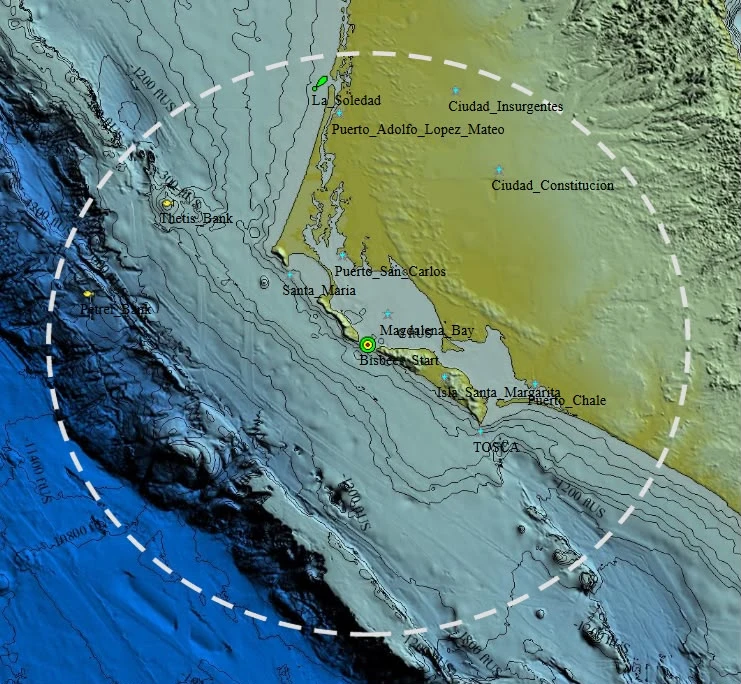
4.1 Tournament Boundary: Teams must fish within a 50-nautical-mile radius from the following designated point: 24° 32.032′ N, 112° 01.817′ W.
4.2 Boundary Illustration: The official tournament outline identifies the fishing area as a 50-nautical-mile radius from the designated Magdalena Bay coordinate. The boundary map included in the tournament materials is intended to illustrate the designated fishing area.
5 Eligible Billfish and Point Structure
5.1 Eligible Species: Eligible billfish species are Striped Marlin, Black Marlin, Blue Marlin, Sailfish, and Spearfish.
5.2 Release Format: The tournament is an all-release billfish tournament. Eligible billfish are scored through verified catch-and-release documentation.
| Eligible Species | Points |
|---|---|
| Striped Marlin | 100 points |
| Black Marlin | 100 points |
| Blue Marlin | 100 points |
| Sailfish | 100 points |
| Spearfish | 100 points |
5.3 Equal Point Value: All eligible billfish species carry the same point value: 100 points per verified release.
6 Daily Jackpots
6.1 Optional Daily Jackpots: Daily Jackpots are optional. A team may enter none, one, all, or any combination of the available Daily Jackpot levels.
6.2 Three-Day Commitment: If a team enters a particular Daily Jackpot level, the team must enter that level for all three of its selected fishing days.
6.3 Daily Jackpot Entry Fees: The available Daily Jackpot levels are $500 per day ($1,500 three-day entry), $1,000 per day ($3,000 three-day entry), and $2,000 per day ($6,000 three-day entry). Jackpot fees are per team.
6.4 Daily Jackpot Competition: Daily Jackpots are based on each team’s individual Day 1, Day 2, and Day 3 of fishing, regardless of the actual calendar dates selected. For example, if one team’s Day 1 is November 4 and another team’s Day 1 is November 12, both teams compete against each other in the Day 1 Daily Jackpot category.
6.5 Daily Jackpot Awards: Daily Jackpots return eighty-five percent (85%) to awards. The applicable award structure and payment are subject to the number of teams entered and the official tournament accounting.
7 Overall Jackpots and Base Entry Awards
7.1 Mandatory Base Entry: The mandatory Base Entry is $2,500 per team.
7.2 Overall Winner-Take-All Jackpots: Optional Overall Winner Takes All jackpots are available at $3,000 and $5,000 per team.
7.3 Overall Billfish Prize Categories: Overall Billfish awards are based on the top overall billfish release point-earning teams at the conclusion of the tournament.
7.4 Base Entry Cash Award Pool: Seventy percent (70%) of the $2,500 tournament Base Entry fees is available for cash awards in the Overall Prize Categories.
7.5 Overall Prize Distribution: The Overall Prize Categories are distributed 50% to first place, 30% to second place, and 20% to third place.
Tournament Entry Levels, Fees & Awards
| Category | Entry / Jackpot | Award / Payout |
|---|---|---|
| Mandatory Base Entry | $2,500 | $1,750 |
| Optional Jackpot | $3,000 | Overall Winner Takes All |
| Optional Jackpot | $5,000 | Overall Winner Takes All |
| Daily Jackpot | $500 | $1,500 Total — 3 Days |
| Daily Jackpot | $1,000 | $3,000 Total — 3 Days |
| Daily Jackpot | $2,000 | $6,000 Total — 3 Days |
| Across the Board | — | $21,000 |
8 Video Verification & Equipment Requirements
8.1 All teams are solely responsible for providing and maintaining the equipment necessary to record, save, and upload qualifying release videos through the official CatchStat platform.
A “Captain’s Catch Log” will be available for teams to download and print should they choose to document their release times during fishing. However, the GPS location, date, and time captured on video will be the official record for determining the timing and validity of each release.
Each team must provide its own video recording equipment and is responsible for knowing how to properly operate that equipment. Teams must not delete any video recorded during official fishing hours, including footage that does not contain all of the required elements to verify a catch.
To qualify as an official release, the submitted video footage must clearly document all of the following:
- 1 Species: Clearly identify the species of the fish while the fish is hooked.
- 2 Angler: Clearly identify the angler while the fish is hooked.
- 3 Leader Verification: Clearly show either the leader wound inside the rod tip, the swivel touching the rod tip while the fish is still hooked, or a team member, angler, or crew member physically touching the leader while the fish is still hooked.
- 4 Release Separator: Clearly identify the Release Separator designated for that fishing day prior to Lines In.
- 5 GPS Location, Date and Time: Each release video must clearly show the GPS location, date, and time by panning the camera to the vessel’s GPS/navigation display. If multiple fish are hooked and released during one continuous, uninterrupted video, the GPS location, date, and time captured at the end of the video will apply to all qualifying releases documented within that video.
- 6 Release: Clearly show that the fish has been fully released.
8.2 Electronic Submission: All release videos must be submitted electronically through the official CatchStat mobile application (iOS/Android) or web platform. A team member’s email address must be included on the official team roster and properly linked to CatchStat so that the team’s “My Teams” page is accessible after sign-in. Teams unable to access their “My Teams” page must contact Tournament Control for assistance.
All required video evidence must be submitted no later than 8:00 p.m. local time on the applicable fishing day. No additional videos or photographs will be accepted after the submission deadline.
8.3 Required Recording Device: Each team must have a functioning video recording device capable of producing clear video evidence of each catch and release.
8.4 Upload Capability: Each team must have a reliable method of uploading videos and tournament data through the CatchStat mobile application or web platform.
8.5 Power, Storage, and Connectivity: Teams must have sufficient battery power, charging capability, storage capacity, and internet or cellular access necessary to complete all required tournament submissions.
8.6 GPS and Date/Time: All devices used for tournament submissions must have properly functioning GPS and accurate date and time settings.
8.7 Backup Equipment: Teams are strongly encouraged to carry backup recording devices, charging equipment, memory storage, and redundant internet or cellular upload capability.
8.8 Failure to Submit Qualifying Video: Failure to successfully record, save, upload, or submit a qualifying release video for any reason—including equipment malfunction, operator error, poor video quality, corrupted files, AI-generated content, loss of internet connectivity, or incomplete uploads—will result in the catch being disqualified and ineligible for points or awards.
8.9 Required Evidence: All submitted videos must clearly document the catch, required leader verification, Release Separator, and release of the fish, along with GPS location, date and time.
8.10 Video Review: Tournament Officials reserve the right to reject any submission that is incomplete, unclear, altered, manipulated, or otherwise fails to meet the tournament’s verification standards.
8.11 No Technical Exceptions: No exceptions will be made for technical failures, damaged equipment, connectivity issues, operator error, or missed submission deadlines.
8.12 Official Platform: CatchStat is the official platform for tournament video submission, scoring, and electronic tournament administration.
8.13 Verification: Only releases successfully submitted and verified in accordance with the tournament’s video requirements will receive tournament points.
8.14 Official Billfish Release: A billfish is considered officially released when the leader connection or swivel is wound to the tip of the rod, or when a person on the boat touches the leader while the fish is hooked.
8.15 Official Results: CatchStat is the official tournament platform for submission, verification, scoring, and electronic standings. Official tournament results will be based on qualifying releases verified and scored through CatchStat in accordance with these Rules. Electronic standings displayed on CatchStat are provisional until the required verification and final review have been completed by Tournament Officials. The final results approved by Tournament Officials will constitute the official tournament results.
9 General Tournament Conditions
9.1 Compliance: By registering, paying entry fees, selecting fishing days, or participating in the tournament, each team agrees to comply with these Official Tournament Rules and all official instructions issued by the Tournament Organizers.
9.2 Rule Enforcement: Tournament Officials may reject any catch, video, scorecard, or submission that does not satisfy the requirements of these Official Tournament Rules.
9.3 Disqualification: A catch that fails the required verification standards is ineligible for points and awards. Where a rule violation warrants team disqualification, the entire team is disqualified and forfeits applicable entry money, prizes, and prize money.
9.4 Final Authority: The Tournament Organizers retain final authority over interpretation and enforcement of these rules and over the verification of tournament catches and results.
10 Angling Regulations
The Bisbee’s Tournaments are “Team” Tournaments. The following angling regulations govern how fish may be fought and handled.
10.1 Team Angling Rules
- (a) The tournament does not regulate who may be involved in the management of, or the manipulation of, the equipment and/or tackle leading up to, during, or following the playing of a fish. This means that more than one angler may fight a single fish. However, only one angler at a time may fight an individual fish.
- (b) Once a fish is hooked, the rod/reel involved in playing the fish must stay in physical contact with the angler(s). It may not be set into a rod holder, rested on the gunwale, or placed on any other object at any time while the fish is being played.
- (c) When a fish is hooked or entangled on more than one line, the team must cut away the extra line(s) as quickly as possible.
- (d) From the time that a fish strikes, anyone onboard may remove other lines, teasers, and devices from the water.
- (e) Once the leader is brought within grasp of the crew, or the end of the leader is wound to the rod tip, more than one person is permitted to touch the leader; this DOES NOT apply to the double line.
10.2 Acts That Disqualify a Catch
Any of the following acts will result in the disqualification of the individual catch. Repeated or intentional violations may result in full team disqualification under Rule 9.3 at the discretion of the Tournament Committee.
- (1) Failure to comply with the tournament’s general, equipment, or angling rules and regulations.
- (2) Resting the rod in a rod holder, on the gunwale of the boat, or any other object while playing the fish.
- (3) Handlining or using a handline or rope attached in any manner to the angler’s line or leader for the purpose of holding or lifting fish.
- (4) Shooting, harpooning, or lancing any fish at any stage of the catch.
- (5) Chumming with or using as bait the flesh, blood, skin, or any part of mammals other than hair or pork rind used in lures designed for trolling or casting.
- (6) Using a boat or device to beach or drive a fish into shallow water in order to deprive the fish of its normal ability to swim.
- (7) Changing the rod or reel while the fish is being played.
- (8) Splicing, removing, or adding to the line while the fish is being played.
- (9) Using a size or kind of bait that is illegal to possess.
- (10) Attaching the angler’s line or leader to part of a boat or other object for the purpose of holding or lifting fish.
- (11) When a rod breaks while a fish is being played in a manner that reduces the length of the tip below the minimum length (40 inches) or severely impairs its angling characteristics.
11 Tackle and Equipment
11.1 Fishing Line and Backing
- a. The term “Backing” pertains to any line on the reel that precedes the “Fishing Line” whether connected to the fishing line or not. The use of backing is permissible and does not have a maximum strength limit. The term “Fishing Line” pertains to the first 16.5 feet (5 meters) of line directly preceding the double line, leader, or hook. This section of fishing line must be comprised of a single, homogenous piece of line, and have a “Manufacturer’s Stated” maximum breaking strength of 130 lbs. or less. The catch shall be classified under the breaking strength of the Fishing Line and must be a minimum length of the stated 16.5 feet (5 meters).
- b. Dacron, monofilament, multifilament, and lead core multifilament lines may be used. Line by the trade name of Spectra is acceptable. Wire lines are prohibited.
11.2 Double Line
The use of a double line is not required. If one is used, it must meet the following specifications:
- a. A double line must consist of the actual Fishing Line used to catch the fish.
- b. Double lines are measured from the start of the knot, braid, roll or splice making the double line to the farthermost end of the knot, splice, snap, swivel or other device used for securing the trace, leader, lure or hook to the double line.
- c. The double line on all classes of tackle shall be limited to 30 feet. The maximum combined length of the double line and leader is 40 feet.
11.3 Leader
The use of a leader is not required. If one is used, it must meet the following specifications:
- a. The length of the leader is the overall length including any lure, hook arrangement or other device and is measured to the bend of the last hook.
- b. The leader must be connected to the line with a snap, knot, splice, swivel or other device.
- c. There are no regulations regarding the material or strength of the leader.
- d. The leader on all classes of tackle shall be limited to 30 feet. The combined length of the double line and leader shall be limited to 40 feet.
11.4 Rod
- a. Rods must comply with sporting ethics and customs.
- b. The rod tip must be a minimum of 40 inches in length. The rod butt cannot exceed 27 inches.
- c. These measurements must be made from a point directly beneath the center of the reel. A curved butt is measured in a straight line.
11.5 Reel
- a. Reels must comply with sporting ethics and customs.
- b. Power driven reels of any kind are prohibited. This includes motor, hydraulic, or electrically driven reels, and any device which gives the angler an unfair advantage.
- c. Ratchet handle reels are prohibited.
- d. Reels designed to be cranked with both hands at the same time are prohibited.
11.6 Hooks — Natural Bait (Live or Dead)
- a. Any hook used with natural bait, live or dead, must be a non-offset circle hook.
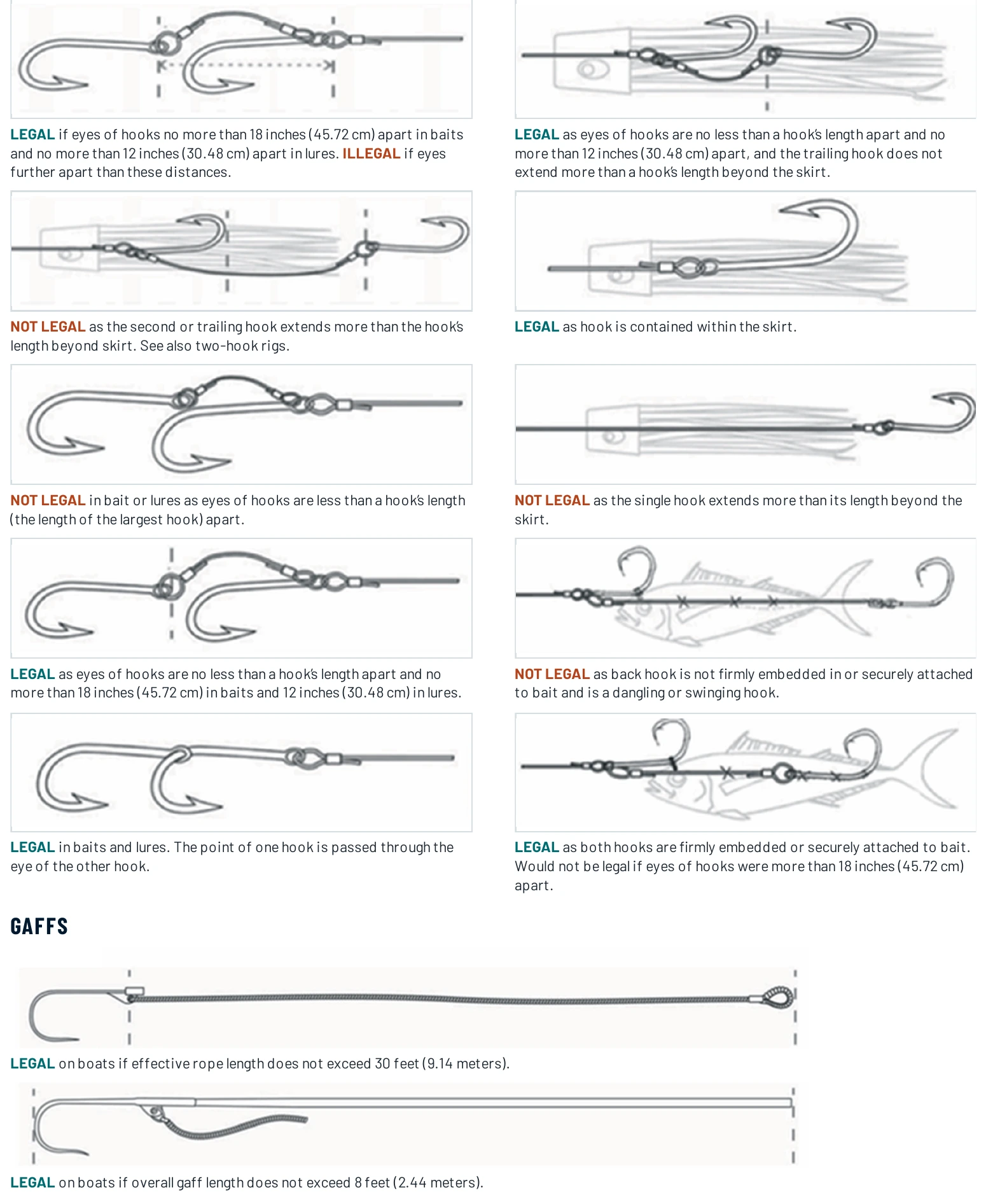
- b. No more than two single hooks may be used. Both must be firmly embedded in or securely attached to the bait. The eyes of the hooks must be no less than a hook’s length (the length of the largest hook used) apart and no more than 18 inches apart. The only exception is that the point of one hook may be passed through the eye of the other hook.
- c. A hook may not precede the bait, or bait/lure combo by more than one hook’s length.
- d. The use of a dangling/swinging hook is prohibited. No double or treble hooks.
11.7 Hooks — Artificial Lures
- a. When using an artificial lure with a skirt or trailing material, no more than two single hooks may be attached to the line, leader, or trace. The hooks need not be attached separately. The eyes of the hooks must be no less than an overall hook’s length (the overall length of the largest hook used) apart and no more than 12 inches apart. The only exception is that the point of one hook may be passed through the eye of the other hook. The trailing hook may not extend more than a hook’s length beyond the skirt of the lure.
- b. A hook may not precede the lure or bait/lure combo by more than one hook’s length.
- c. The tournament recognizes products produced by Quick Rig Corporation under the trade name “Double Trouble Hooks” as acceptable tackle to be used in the tournament.
11.8 Other Equipment
- a. Fighting chairs may not have any mechanically propelled devices that aid the angler in fighting.
- b. Gimbals must be free swinging. Gimbals that allow anglers to reduce strain or rest while fighting the fish are prohibited.
- c. Harnesses may be attached to the reel or rod, but not to the fighting chair. The harness may be replaced or adjusted by a person other than the angler.
- d. Rod belts or waist gimbals are permitted.
- e. Gaffs used to boat a fish must not exceed 8 feet in overall length. In using a flying or detachable gaff the rope may not exceed 30 feet. The gaff rope is measured from the point where it is secured to the detachable head to the other end. If a fixed head gaff is used, the same limitations shall apply and the gaff rope shall be measured from the same location on the gaff hook. Only a single hook is permitted on any gaff. Harpoon or lance attachments are prohibited. Tail ropes are limited to 30 feet.
- f. Entangling devices, with or without a hook, are prohibited and may not be used for any purpose including baiting, hooking, fighting, or landing the fish.
- g. Nets may not be used to obtain a fish.
- h. Outriggers, downriggers, spreader bars, and kites are permitted to be used, provided that the actual fishing line is attached to a snap or other release device, either directly or with some other material. The leader or double line may not be connected to the release mechanism either directly or with the use of a connecting device. Spreader bars are also acceptable when used strictly as a teaser.
- i. Daisy chains, birds, floats, and similar devices may only be used if they do not unfairly hamper or inhibit the normal swimming or fighting ability of the fish, thereby giving the team an unfair advantage in fighting, releasing, or boating the fish. Acceptability of this equipment will be determined by the Tournament Organizers on an individual, as-needed basis.
- j. A safety line may be attached to the rod provided it does not in any way assist the angler in fighting the fish.
Hooks & Gaffs — Illustrated
12 Enforcement, Protests and Legal
12.1 Participant Eligibility and Representations: By registering for or participating in the tournament, each Participant represents and warrants that: (a) they are at least 18 years of age, or if under 18, that a parent or legal guardian assumes responsibility on their behalf; (b) they are physically fit and capable of participating in offshore deep sea fishing activities; and (c) they are not aware of any medical condition that would create an unreasonable risk to themselves or others during the tournament. The Tournament Organizers reserve the right to require proof of age or written parental/guardian consent for any Participant who appears to be a minor.
12.2 Disputes and Protests: Participants may lodge protests against any catch which they believe was not made in accordance with these rules. All protests must be stated in writing and accompanied by a $1,000 deposit. All protests must be in the hands of the tournament’s designated rules officials by 9:00 p.m. on the day of the alleged incident. All protests will be settled on the day of the incident unless the tournament committee determines more time is necessary. If the protest is upheld, the $1,000 deposit will be refunded in full. If the protest is denied, the deposit is forfeited to the tournament. Official tournament video footage will be viewed by the tournament committee to verify or disqualify all reported catches. Decisions of the tournament committee regarding protests are final, non-appealable, and nonjusticiable, and are binding upon all parties.
12.3 Polygraph Examination: Upon request, one person from each team receiving a cash award must complete a polygraph examination. This person must have been directly involved with either the release or the capture of the fish (angler, captain, or wireman). The final selection of the person to receive the examination is made by Tournament Officials. Failure to comply, or failing the examination, results in disqualification. The tournament reserves the right, at its discretion, to polygraph multiple team members but does not guarantee that it will polygraph more than one person.
12.4 Release of All Claims and Assumption of Risk: (This section should be carefully read by each Participant.) As set forth in Rule 1.1, by registering for, paying the entry fee for, or participating in the Bisbee’s Tournaments Inc. (“the Tournament”), each Participant hereby releases, forever discharges, and agrees to hold harmless Tournament Promotions Inc., CatchStat, and their respective officers, directors, employees, agents, volunteers, partners, members, sponsors, and/or attorneys (collectively the “Releasees”) for any and all losses, claims, or demands of any kind whatsoever arising from the negligence of the Releasees or from any other cause connected with, or occurring during the Tournament. Each Participant further acknowledges and agrees that activities relating to deep sea fishing are extremely dangerous and involve the risk of serious injury or death. With full knowledge of these risks, each Participant voluntarily assumes full responsibility for the risk of bodily injury or death due to the negligence or gross negligence of the Releasees or any other cause connected with or occurring during the Tournament. This release is binding upon each Participant and their heirs, executors, administrators, and assigns.
12.5 Indemnification: Each Participant agrees to indemnify, defend, and hold harmless the Releasees (as defined in Rule 12.4) from and against any and all claims, damages, losses, costs, and expenses (including reasonable attorneys’ fees) arising out of or related to: (a) the Participant’s breach of these tournament rules; (b) the Participant’s negligent or intentional acts or omissions during the tournament; or (c) any third-party claim resulting from the Participant’s conduct during the tournament. This indemnification obligation survives the conclusion of the tournament.
12.6 Media Participation: The Participants specifically agree that any photograph, motion picture, or audio recording in which they appear or are heard may be used by Tournament Organizers for any purpose whatsoever including, but not limited to, resale, advertising, and promotional material without compensation or restriction of any kind.
12.7 Governing Law and Jurisdiction: These tournament rules and any disputes arising out of or related to the tournament shall be governed by and construed in accordance with the laws of Mexico. The Participants irrevocably consent to the exclusive jurisdiction of the courts located in Los Cabos, Baja California Sur, Mexico for the resolution of any disputes arising under these rules or in connection with the tournament. Notwithstanding the foregoing, the Tournament Organizers reserve the right to seek injunctive or other equitable relief in any court of competent jurisdiction.
12.8 Severability: If any provision of these tournament rules or the Release of All Claims is found to be invalid, illegal, or unenforceable by a court of competent jurisdiction, such finding shall not affect the validity, legality, or enforceability of the remaining provisions, which shall continue in full force and effect. The invalid or unenforceable provision shall be modified to the minimum extent necessary to make it valid and enforceable while preserving the original intent of the parties.
13 Permits & Licenses
It is the responsibility of registered boat captains and anglers to comply with all Mexican Federal and State laws regarding fishing licenses, size limits, bag limits and any other regulations that may apply. This is a requirement of Mexico and is not a tournament rule; permit and licensing infractions have no bearing on tournament results or awards. Consult the FONMAR website for more information (www.sportfishingbcs.gob.mx).
14 Quick Reference
| Item | Details |
|---|---|
| Registration Deadline | 9:00 p.m. local time, October 31, 2026 |
| Tournament Window | November 1–30, 2026 |
| Fishing Days | Any 3 days selected by the team (declared by 8:00 p.m. local time the day before the fishing day) |
| Official Start Point | The first video uploaded by a team for its declared fishing day must clearly display the vessel’s GPS location, date, and time. The video must verify that the vessel is located within the designated fishing grounds identified by the Tournament Boundary in Section 4.1 no later than 7:30 a.m. local time. |
| Lines In | 7:30 a.m. local time |
| Lines Out | 3:30 p.m. local time |
| Video Upload Deadline | 8:00 p.m. local time |
| Base Entry | $2,500 |
| Overall Jackpots | $3,000 / $5,000 Winner Takes All |
| Daily Jackpots | $500 / $1,000 / $2,000 per day |
| Daily Jackpot Entry | $1,500 / $3,000 / $6,000 for 3 days |
| Eligible Billfish | Striped, Black, Blue Marlin, Sailfish, Spearfish |
| Points | 100 points per verified release |
| Fishing Boundary | 50 NM radius from 24° 32.032′ N, 112° 01.817′ W |
| Official Platform | CatchStat |
15 Tournament Boundary Map
Tournament Boundary: Teams must fish within a 50-nautical-mile radius from the following designated point:
24° 32.032′ N · 112° 01.817′ W
Reglas en Español
AVISO: Esta es una traducción al español de las Reglas Oficiales del Torneo. En caso de discrepancia entre la versión en inglés y la versión en español, prevalecerá la versión en inglés.
Contenido
1 Información del Torneo
1.1 Aceptación de las Reglas: Las reglas, incluidas las publicadas en forma impresa o en el sitio web de Bisbee’s (www.bisbees.com), están sujetas a cambios antes del inicio del torneo. Los equipos serán notificados de cualquier cambio a más tardar en la fecha límite de inscripción, a las 9:00 p.m. hora local del 31 de octubre, por llamada, mensaje de texto, correo electrónico o redes sociales. Se llevará a cabo una Junta de Capitanes Virtual; fechas por confirmar.
Aceptación Vinculante: Al inscribirse, pagar la cuota de inscripción o participar en cualquier calidad en un Torneo Bisbee’s, cada Participante, en lo individual y en nombre de sus herederos, cesionarios y representantes personales, acepta quedar obligado por la totalidad de estas reglas del torneo, incluyendo, de manera enunciativa mas no limitativa, la Liberación de Toda Reclamación (Regla 12.4), la disposición de Indemnización (Regla 12.5), la Asunción de Riesgo y la disposición de Participación en Medios (Regla 12.6). La inscripción y/o el pago de las cuotas de inscripción constituye la aceptación total de todos los términos y condiciones aquí contenidos, independientemente de que el Participante haya firmado o no un documento por separado. Los Participantes aceptan además que todas las decisiones tomadas por los Organizadores del Torneo son definitivas, inapelables y no justiciables.
1.2 Fechas del Torneo: El torneo Bisbee’s Mag Bay Mania 2026 se llevará a cabo durante un periodo de 30 días que comienza el domingo 1 de noviembre de 2026 y termina el lunes 30 de noviembre de 2026.
1.3 Naturaleza del Torneo: Bisbee’s Mag Bay Mania 2026 es un torneo de liberación de picudos totalmente virtual, diseñado para que los equipos compitan en las aguas que rodean Bahía Magdalena (Límite del Torneo, Sección 4.1; Mapa del Límite, Sección 15) durante un periodo flexible de torneo.
1.4 Tres Días de Pesca: Cada equipo inscrito elegirá CUALESQUIERA tres días para pescar dentro del periodo del torneo, del 1 al 30 de noviembre de 2026. Los días elegidos no tienen que ser consecutivos.
1.5 Designación de Días Individuales: El primer día de pesca elegido por cada equipo es el Día 1 de ese equipo, el segundo día de pesca elegido es el Día 2 y el tercer día de pesca elegido es el Día 3. Estas designaciones aplican sin importar las fechas del calendario elegidas.
1.6 Campeón General: Al concluir el periodo del torneo, el equipo con el mayor total de puntos verificados por liberación de picudos será declarado ganador de Bisbee’s Mag Bay Mania 2026.
1.7 Desempate: En caso de empate, la fecha y hora oficiales registradas en el o los videos de liberación elegibles se utilizarán como primer criterio de desempate. El equipo cuyos peces calificados hayan sido liberados primero obtendrá la posición más alta.
Si dos o más equipos tienen exactamente el mismo número de peces calificados y exactamente la misma hora oficial de liberación, el premio correspondiente se dividirá en partes iguales entre los equipos empatados. Por ejemplo, si dos equipos tienen exactamente el mismo número de liberaciones y la misma hora de su última liberación en su Día 1 declarado de pesca, los equipos dividirán el premio diario. Si dos equipos tienen exactamente los mismos puntos generales por liberación y la misma hora de su última liberación, dividirán el premio general y el de la siguiente posición premiada.
2 Inscripción
2.1 Fecha Límite de Inscripción: Los equipos deben inscribirse y pagar la Inscripción Base y todos los Jackpots Opcionales a más tardar a las 9:00 p.m. hora local del 31 de octubre de 2026. No es necesario que los equipos elijan sus días de pesca al momento de inscribirse.
2.2 Administración Virtual: No habrá sede física de inscripción ni Junta de Capitanes presencial. Los materiales de inscripción, la información de los equipos y las comunicaciones del torneo se manejarán de forma electrónica a través de la plataforma CatchStat.
2.3 Formas de Pago Aceptadas: Las formas de pago aceptadas incluyen transferencia electrónica y tarjeta de crédito. Se acepta efectivo ÚNICAMENTE del 12 al 26 de octubre en Cabo; comuníquese con los Organizadores del Torneo para más detalles. Los cheques deben enviarse por correo a más tardar el 1 de octubre de 2026.
2.4 Inscripción Completa: Todas las cuotas de inscripción deben recibirse y verificarse antes de que un equipo se considere oficialmente inscrito en el torneo.
3 Calendario de Pesca
3.1 Punto Oficial de Inicio: El primer video que suba un equipo para su día de pesca declarado debe mostrar claramente la ubicación GPS, la fecha y la hora de la embarcación. El video debe verificar que la embarcación se encuentra dentro de la zona de pesca designada por el Límite del Torneo de la Sección 4.1 a más tardar a las 7:30 a.m. hora local.
3.2 Horario de Pesca: Líneas al Agua (Lines In) es a las 7:30 a.m. hora local y Líneas Fuera (Lines Out) es a las 3:30 p.m. hora local en cada uno de los tres días de pesca elegidos por el equipo.
3.3 Declaración de un Día de Pesca: Antes de pescar, el equipo debe elegir y declarar su(s) día(s) de pesca a más tardar a las 8:00 p.m. hora local del día anterior a su primer día de pesca declarado.
3.4 Cláusula de Cancelación de Día Declarado: Si un equipo no puede pescar en su día de pesca declarado debido a circunstancias imprevistas, deberá notificar a los Organizadores del Torneo a más tardar a la hora de Líneas al Agua (7:30 a.m.) hora local del día de pesca declarado. Si no se notifica dentro de este plazo, el día de pesca declarado seguirá siendo válido y contará como uno de los días de pesca del equipo en el torneo.
3.5 Fecha Límite para Subir Videos: Todo el video de liberación requerido debe subirse a más tardar a las 8:00 p.m. hora local del día de pesca.
3.6 Formato de Tres Días: El torneo consta de tres días de pesca por equipo. El Día 1, Día 2 y Día 3 de los Jackpots Diarios de un equipo se basan en el orden en que ese equipo pesca, no en la fecha del calendario.
4 Límites de Pesca
4.1 Límite del Torneo: Los equipos deben pescar dentro de un radio de 50 millas náuticas a partir del siguiente punto designado: 24° 32.032′ N, 112° 01.817′ W.
4.2 Ilustración del Límite: El esquema oficial del torneo identifica el área de pesca como un radio de 50 millas náuticas a partir de la coordenada designada en Bahía Magdalena. El mapa del límite incluido en los materiales del torneo tiene como fin ilustrar el área de pesca designada.
5 Picudos Elegibles y Estructura de Puntos
5.1 Especies Elegibles: Las especies de picudos elegibles son Marlín Rayado, Marlín Negro, Marlín Azul, Pez Vela y Marlín Trompa Corta.
5.2 Formato de Liberación: El torneo es un torneo de picudos exclusivamente de liberación. Los picudos elegibles se puntúan mediante documentación verificada de captura y liberación.
| Especie Elegible | Puntos |
|---|---|
| Marlín Rayado | 100 puntos |
| Marlín Negro | 100 puntos |
| Marlín Azul | 100 puntos |
| Pez Vela | 100 puntos |
| Marlín Trompa Corta | 100 puntos |
5.3 Mismo Valor en Puntos: Todas las especies de picudos elegibles tienen el mismo valor en puntos: 100 puntos por liberación verificada.
6 Jackpots Diarios
6.1 Jackpots Diarios Opcionales: Los Jackpots Diarios son opcionales. Un equipo puede entrar a ninguno, uno, todos o cualquier combinación de los niveles de Jackpot Diario disponibles.
6.2 Compromiso de Tres Días: Si un equipo entra a un nivel de Jackpot Diario, debe entrar a ese nivel en sus tres días de pesca elegidos.
6.3 Cuotas de los Jackpots Diarios: Los niveles de Jackpot Diario disponibles son $500 USD por día ($1,500 USD por los tres días), $1,000 USD por día ($3,000 USD por los tres días) y $2,000 USD por día ($6,000 USD por los tres días). Las cuotas de los jackpots son por equipo.
6.4 Competencia de los Jackpots Diarios: Los Jackpots Diarios se basan en el Día 1, Día 2 y Día 3 de pesca de cada equipo, sin importar las fechas del calendario elegidas. Por ejemplo, si el Día 1 de un equipo es el 4 de noviembre y el Día 1 de otro equipo es el 12 de noviembre, ambos equipos compiten entre sí en la categoría del Jackpot Diario del Día 1.
6.5 Premios de los Jackpots Diarios: Los Jackpots Diarios destinan el ochenta y cinco por ciento (85%) a premios. La estructura de premios aplicable y su pago están sujetos al número de equipos inscritos y a la contabilidad oficial del torneo.
7 Jackpots Generales y Premios de la Inscripción Base
7.1 Inscripción Base Obligatoria: La Inscripción Base obligatoria es de $2,500 USD por equipo.
7.2 Jackpots Generales “El Ganador se Lleva Todo”: Hay Jackpots Generales opcionales “El Ganador se Lleva Todo” (Winner Takes All) de $3,000 USD y $5,000 USD por equipo.
7.3 Categorías de Premios Generales de Picudos: Los premios Generales de Picudos se basan en los equipos con más puntos por liberación de picudos al concluir el torneo.
7.4 Bolsa de Premios en Efectivo de la Inscripción Base: El setenta por ciento (70%) de las cuotas de Inscripción Base de $2,500 USD se destina a premios en efectivo en las Categorías de Premios Generales.
7.5 Distribución de los Premios Generales: Las Categorías de Premios Generales se distribuyen 50% al primer lugar, 30% al segundo lugar y 20% al tercer lugar.
Niveles de Inscripción, Cuotas y Premios del Torneo
| Categoría | Inscripción / Jackpot | Premio / Pago |
|---|---|---|
| Inscripción Base Obligatoria | $2,500 USD | $1,750 USD |
| Jackpot Opcional | $3,000 USD | General — El Ganador se Lleva Todo |
| Jackpot Opcional | $5,000 USD | General — El Ganador se Lleva Todo |
| Jackpot Diario | $500 USD | $1,500 USD Total — 3 Días |
| Jackpot Diario | $1,000 USD | $3,000 USD Total — 3 Días |
| Jackpot Diario | $2,000 USD | $6,000 USD Total — 3 Días |
| Todas las Categorías | — | $21,000 USD |
8 Verificación por Video y Requisitos de Equipo
8.1 Todos los equipos son los únicos responsables de proporcionar y mantener el equipo necesario para grabar, guardar y subir los videos de liberación calificados a través de la plataforma oficial CatchStat.
Habrá disponible una “Bitácora de Capturas del Capitán” (Captain’s Catch Log) que los equipos podrán descargar e imprimir si desean documentar sus horas de liberación durante la pesca. Sin embargo, la ubicación GPS, la fecha y la hora captadas en el video serán el registro oficial para determinar la hora y la validez de cada liberación.
Cada equipo debe proporcionar su propio equipo de grabación de video y es responsable de saber operarlo correctamente. Los equipos no deben borrar ningún video grabado durante el horario oficial de pesca, incluido el material que no contenga todos los elementos requeridos para verificar una captura.
Para calificar como liberación oficial, el video enviado debe documentar claramente todo lo siguiente:
- 1 Especie: Identificar claramente la especie del pez mientras está enganchado.
- 2 Pescador: Identificar claramente al pescador mientras el pez está enganchado.
- 3 Verificación del Líder: Mostrar claramente el líder enrollado dentro de la punta de la caña, el destorcedor tocando la punta de la caña mientras el pez sigue enganchado, o a un miembro del equipo, pescador o tripulante tocando físicamente el líder mientras el pez sigue enganchado.
- 4 Separador de Liberación (Release Separator): Identificar claramente el Separador de Liberación designado para ese día de pesca antes de Líneas al Agua.
- 5 Ubicación GPS, Fecha y Hora: Cada video de liberación debe mostrar claramente la ubicación GPS, la fecha y la hora, enfocando la cámara hacia la pantalla GPS/de navegación de la embarcación. Si se enganchan y liberan varios peces durante un solo video continuo e ininterrumpido, la ubicación GPS, la fecha y la hora captadas al final del video aplicarán a todas las liberaciones calificadas documentadas en ese video.
- 6 Liberación: Mostrar claramente que el pez ha sido liberado por completo.
8.2 Envío Electrónico: Todos los videos de liberación deben enviarse electrónicamente a través de la aplicación móvil oficial de CatchStat (iOS/Android) o de la plataforma web. El correo electrónico de un miembro del equipo debe estar incluido en la lista oficial del equipo y vinculado correctamente a CatchStat, de modo que la página “My Teams” del equipo sea accesible después de iniciar sesión. Los equipos que no puedan acceder a su página “My Teams” deben comunicarse con Control del Torneo para recibir ayuda.
Toda la evidencia en video requerida debe enviarse a más tardar a las 8:00 p.m. hora local del día de pesca correspondiente. No se aceptarán videos ni fotografías adicionales después de la fecha límite de envío.
8.3 Dispositivo de Grabación Requerido: Cada equipo debe contar con un dispositivo de grabación de video funcional, capaz de producir evidencia clara en video de cada captura y liberación.
8.4 Capacidad para Subir Archivos: Cada equipo debe contar con un medio confiable para subir videos y datos del torneo a través de la aplicación móvil o la plataforma web de CatchStat.
8.5 Energía, Almacenamiento y Conectividad: Los equipos deben contar con suficiente batería, capacidad de carga, capacidad de almacenamiento y acceso a internet o red celular para completar todos los envíos requeridos del torneo.
8.6 GPS y Fecha/Hora: Todos los dispositivos utilizados para los envíos del torneo deben tener un GPS que funcione correctamente y la fecha y hora configuradas con precisión.
8.7 Equipo de Respaldo: Se recomienda ampliamente que los equipos lleven dispositivos de grabación de respaldo, equipo de carga, memoria de almacenamiento y un medio alterno de conexión a internet o red celular para subir archivos.
8.8 Falta de Envío de Video Calificado: No grabar, guardar, subir o enviar con éxito un video de liberación calificado por cualquier motivo —incluyendo falla del equipo, error del operador, mala calidad de video, archivos dañados, contenido generado con inteligencia artificial, pérdida de conexión a internet o cargas incompletas— resultará en la descalificación de la captura, que no será elegible para puntos ni premios.
8.9 Evidencia Requerida: Todos los videos enviados deben documentar claramente la captura, la verificación del líder requerida, el Separador de Liberación y la liberación del pez, junto con la ubicación GPS, la fecha y la hora.
8.10 Revisión de Videos: Los Oficiales del Torneo se reservan el derecho de rechazar cualquier envío que esté incompleto, sea poco claro, esté alterado o manipulado, o que de cualquier otra forma no cumpla con los estándares de verificación del torneo.
8.11 Sin Excepciones Técnicas: No se harán excepciones por fallas técnicas, equipo dañado, problemas de conectividad, error del operador o fechas límite de envío no cumplidas.
8.12 Plataforma Oficial: CatchStat es la plataforma oficial para el envío de videos, la puntuación y la administración electrónica del torneo.
8.13 Verificación: Solo las liberaciones enviadas y verificadas con éxito conforme a los requisitos de video del torneo recibirán puntos del torneo.
8.14 Liberación Oficial de Picudo: Un picudo se considera oficialmente liberado cuando la conexión del líder o el destorcedor se enrolla hasta la punta de la caña, o cuando una persona a bordo toca el líder mientras el pez está enganchado.
8.15 Resultados Oficiales: CatchStat es la plataforma oficial del torneo para el envío, la verificación, la puntuación y las posiciones electrónicas. Los resultados oficiales del torneo se basarán en las liberaciones calificadas verificadas y puntuadas a través de CatchStat conforme a estas Reglas. Las posiciones electrónicas que se muestran en CatchStat son provisionales hasta que los Oficiales del Torneo completen la verificación requerida y la revisión final. Los resultados finales aprobados por los Oficiales del Torneo constituirán los resultados oficiales del torneo.
9 Condiciones Generales del Torneo
9.1 Cumplimiento: Al inscribirse, pagar las cuotas de inscripción, elegir días de pesca o participar en el torneo, cada equipo acepta cumplir con estas Reglas Oficiales del Torneo y con todas las instrucciones oficiales que emitan los Organizadores del Torneo.
9.2 Aplicación de las Reglas: Los Oficiales del Torneo pueden rechazar cualquier captura, video, tarjeta de puntuación o envío que no cumpla con los requisitos de estas Reglas Oficiales del Torneo.
9.3 Descalificación: Una captura que no cumpla con los estándares de verificación requeridos no es elegible para puntos ni premios. Cuando una violación a las reglas amerite la descalificación del equipo, todo el equipo será descalificado y perderá las cuotas de inscripción, premios y dinero de premios correspondientes.
9.4 Autoridad Final: Los Organizadores del Torneo conservan la autoridad final sobre la interpretación y aplicación de estas reglas y sobre la verificación de las capturas y los resultados del torneo.
10 Reglamento de Pesca
Los Torneos Bisbee’s son torneos “por Equipo”. El siguiente reglamento de pesca rige la forma en que se pueden pelear y manejar los peces.
10.1 Reglas de Pesca por Equipo
- (a) El torneo no regula quién puede participar en el manejo o la manipulación del equipo y/o aparejos antes, durante o después de la pelea de un pez. Esto significa que más de un pescador puede pelear un mismo pez. Sin embargo, solo un pescador a la vez puede pelear un pez individual.
- (b) Una vez enganchado el pez, la caña/carrete con que se pelea el pez debe permanecer en contacto físico con el o los pescadores. No se puede colocar en un portacañas, apoyar en la borda ni colocar sobre ningún otro objeto en ningún momento mientras se pelea el pez.
- (c) Cuando un pez quede enganchado o enredado en más de una línea, el equipo debe cortar la(s) línea(s) adicional(es) lo más rápido posible.
- (d) Desde el momento en que un pez pica, cualquier persona a bordo puede retirar del agua otras líneas, teasers y dispositivos.
- (e) Una vez que el líder está al alcance de la tripulación, o que el extremo del líder se ha enrollado hasta la punta de la caña, se permite que más de una persona toque el líder; esto NO APLICA a la línea doble.
10.2 Actos que Descalifican una Captura
Cualquiera de los siguientes actos resultará en la descalificación de la captura individual. Las violaciones repetidas o intencionales pueden resultar en la descalificación total del equipo conforme a la Regla 9.3, a discreción del Comité del Torneo.
- (1) No cumplir con las reglas y reglamentos generales, de equipo o de pesca del torneo.
- (2) Apoyar la caña en un portacañas, en la borda de la embarcación o en cualquier otro objeto mientras se pelea el pez.
- (3) Jalar a mano la línea o usar una línea de mano o cuerda sujeta de cualquier forma a la línea o al líder del pescador con el propósito de sostener o levantar el pez.
- (4) Disparar, arponear o lancear cualquier pez en cualquier etapa de la captura.
- (5) Cebar (chum) con, o usar como carnada, la carne, sangre, piel o cualquier parte de mamíferos, salvo pelo o piel de cerdo utilizados en señuelos diseñados para curricán o lanzado.
- (6) Usar una embarcación o dispositivo para varar o conducir un pez hacia aguas poco profundas con el fin de privarlo de su capacidad normal de nado.
- (7) Cambiar la caña o el carrete mientras se pelea el pez.
- (8) Empalmar, quitar o agregar línea mientras se pelea el pez.
- (9) Usar un tamaño o tipo de carnada cuya posesión sea ilegal.
- (10) Sujetar la línea o el líder del pescador a alguna parte de la embarcación u otro objeto con el propósito de sostener o levantar el pez.
- (11) Cuando una caña se rompe mientras se pelea el pez de manera que la punta queda por debajo de la longitud mínima (40 pulgadas) o se afectan gravemente sus características de pesca.
11 Aparejos y Equipo
11.1 Línea de Pesca y Backing
- a. El término “Backing” se refiere a cualquier línea en el carrete que precede a la “Línea de Pesca”, esté o no conectada a ella. Se permite el uso de backing y no tiene límite máximo de resistencia. El término “Línea de Pesca” se refiere a los primeros 16.5 pies (5 metros) de línea que preceden directamente a la línea doble, al líder o al anzuelo. Esta sección de la línea de pesca debe consistir en una sola pieza homogénea de línea y tener una resistencia máxima a la ruptura “Declarada por el Fabricante” de 130 lbs. o menos. La captura se clasificará según la resistencia a la ruptura de la Línea de Pesca, la cual debe tener una longitud mínima de los 16.5 pies (5 metros) indicados.
- b. Se pueden usar líneas de Dacron, monofilamento, multifilamento y multifilamento con núcleo de plomo. Se acepta la línea con el nombre comercial Spectra. Se prohíben las líneas de alambre.
11.2 Línea Doble
El uso de línea doble no es obligatorio. Si se usa, debe cumplir con las siguientes especificaciones:
- a. La línea doble debe estar formada por la misma Línea de Pesca utilizada para capturar el pez.
- b. La línea doble se mide desde el inicio del nudo, trenzado, enrollado o empalme que forma la línea doble hasta el extremo más lejano del nudo, empalme, broche, destorcedor u otro dispositivo utilizado para sujetar el trace, líder, señuelo o anzuelo a la línea doble.
- c. La línea doble en todas las clases de aparejo se limita a 30 pies. La longitud máxima combinada de la línea doble y el líder es de 40 pies.
11.3 Líder
El uso de líder no es obligatorio. Si se usa, debe cumplir con las siguientes especificaciones:
- a. La longitud del líder es la longitud total, incluyendo cualquier señuelo, arreglo de anzuelos u otro dispositivo, y se mide hasta la curva del último anzuelo.
- b. El líder debe conectarse a la línea con un broche, nudo, empalme, destorcedor u otro dispositivo.
- c. No hay reglamento respecto al material o la resistencia del líder.
- d. El líder en todas las clases de aparejo se limita a 30 pies. La longitud combinada de la línea doble y el líder se limita a 40 pies.
11.4 Caña
- a. Las cañas deben cumplir con la ética y las costumbres deportivas.
- b. La punta de la caña debe medir un mínimo de 40 pulgadas. El mango (butt) de la caña no puede exceder 27 pulgadas.
- c. Estas medidas deben tomarse desde un punto directamente debajo del centro del carrete. Un mango curvo se mide en línea recta.
11.5 Carrete
- a. Los carretes deben cumplir con la ética y las costumbres deportivas.
- b. Se prohíben los carretes accionados por motor de cualquier tipo. Esto incluye carretes de motor, hidráulicos o eléctricos, y cualquier dispositivo que dé al pescador una ventaja injusta.
- c. Se prohíben los carretes con manivela de trinquete.
- d. Se prohíben los carretes diseñados para accionarse con ambas manos al mismo tiempo.
11.6 Anzuelos — Carnada Natural (Viva o Muerta)
- a. Todo anzuelo utilizado con carnada natural, viva o muerta, debe ser un anzuelo circular sin desviación (non-offset).
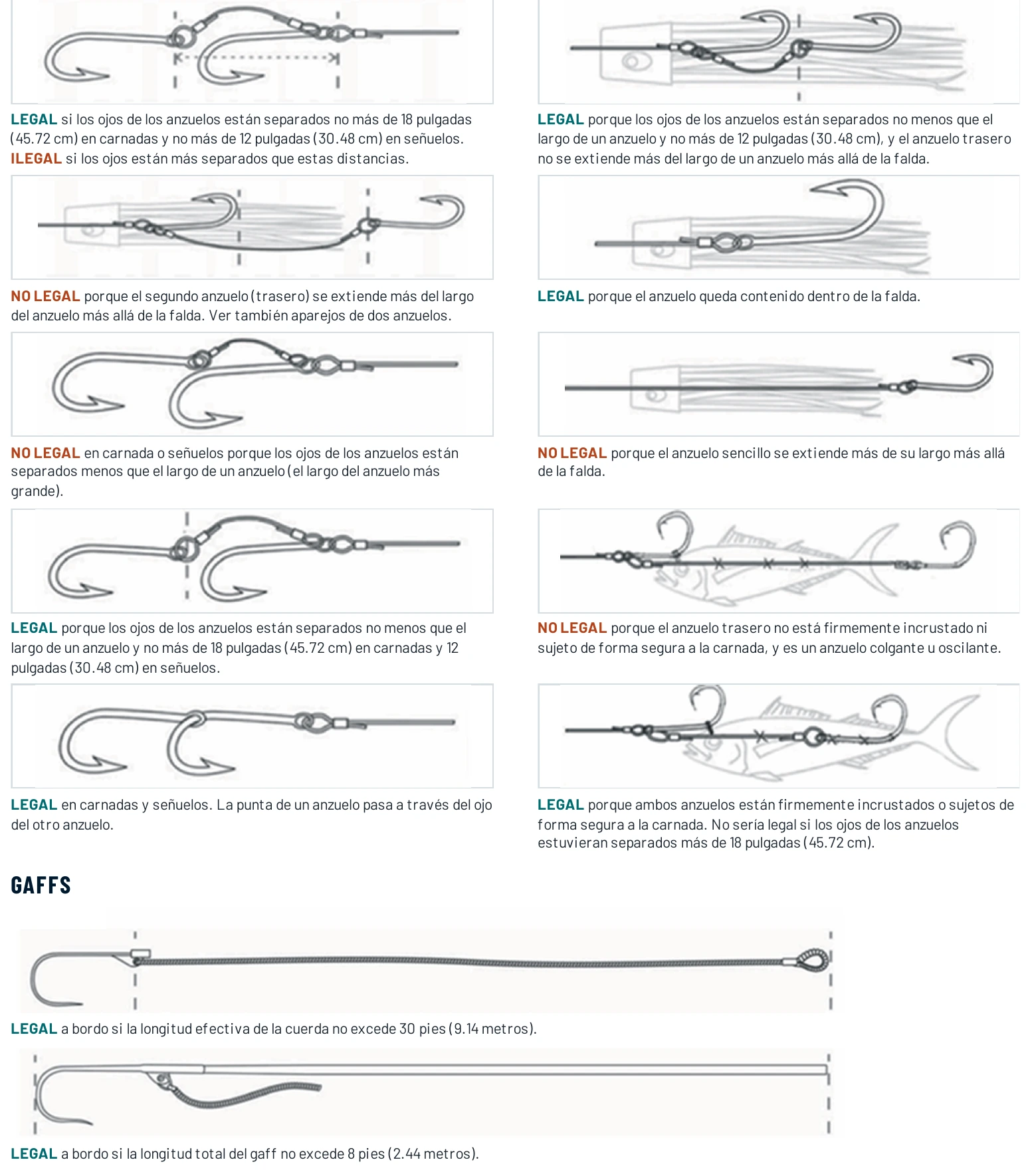
- b. No se pueden usar más de dos anzuelos sencillos. Ambos deben estar firmemente incrustados o sujetos de forma segura a la carnada. Los ojos de los anzuelos deben estar separados no menos que el largo de un anzuelo (el largo del anzuelo más grande utilizado) y no más de 18 pulgadas. La única excepción es que la punta de un anzuelo puede pasar a través del ojo del otro anzuelo.
- c. Un anzuelo no puede preceder a la carnada, o a la combinación carnada/señuelo, por más del largo de un anzuelo.
- d. Se prohíbe el uso de un anzuelo colgante u oscilante. No se permiten anzuelos dobles ni triples.
11.7 Anzuelos — Señuelos Artificiales
- a. Al usar un señuelo artificial con falda o material colgante, no se pueden sujetar más de dos anzuelos sencillos a la línea, líder o trace. No es necesario que los anzuelos se sujeten por separado. Los ojos de los anzuelos deben estar separados no menos que el largo total de un anzuelo (el largo total del anzuelo más grande utilizado) y no más de 12 pulgadas. La única excepción es que la punta de un anzuelo puede pasar a través del ojo del otro anzuelo. El anzuelo trasero no puede extenderse más del largo de un anzuelo más allá de la falda del señuelo.
- b. Un anzuelo no puede preceder al señuelo, o a la combinación carnada/señuelo, por más del largo de un anzuelo.
- c. El torneo reconoce los productos fabricados por Quick Rig Corporation bajo el nombre comercial “Double Trouble Hooks” como aparejo aceptable para usarse en el torneo.
11.8 Otro Equipo
- a. Las sillas de pelea no pueden tener ningún dispositivo de propulsión mecánica que ayude al pescador durante la pelea.
- b. Los gimbals deben girar libremente. Se prohíben los gimbals que permitan al pescador reducir el esfuerzo o descansar mientras pelea el pez.
- c. Los arneses pueden sujetarse al carrete o a la caña, pero no a la silla de pelea. El arnés puede ser reemplazado o ajustado por una persona distinta del pescador.
- d. Se permiten cinturones de pelea o gimbals de cintura.
- e. Los gaffs utilizados para subir un pez a bordo no deben exceder 8 pies de longitud total. Al usar un gaff volador o de cabeza desmontable, la cuerda no puede exceder 30 pies. La cuerda del gaff se mide desde el punto donde se sujeta a la cabeza desmontable hasta el otro extremo. Si se usa un gaff de cabeza fija, aplican las mismas limitaciones y la cuerda se mide desde el mismo punto en el gancho del gaff. Solo se permite un gancho sencillo en cualquier gaff. Se prohíben los aditamentos de arpón o lanza. Las cuerdas de cola se limitan a 30 pies.
- f. Se prohíben los dispositivos de enredo, con o sin anzuelo, y no pueden usarse para ningún propósito, incluyendo encarnar, enganchar, pelear o subir el pez a bordo.
- g. No se pueden usar redes para obtener un pez.
- h. Se permite el uso de tangones (outriggers), downriggers, barras separadoras (spreader bars) y papalotes (kites), siempre que la línea de pesca esté sujeta a un broche u otro dispositivo de liberación, ya sea directamente o con algún otro material. El líder o la línea doble no pueden conectarse al mecanismo de liberación, ni directamente ni mediante un dispositivo de conexión. Las barras separadoras también son aceptables cuando se usan estrictamente como teaser.
- i. Los daisy chains, pájaros (birds), flotadores y dispositivos similares solo pueden usarse si no obstaculizan ni limitan injustamente la capacidad normal de nado o de pelea del pez, dando así al equipo una ventaja injusta para pelear, liberar o subir el pez a bordo. La aceptabilidad de este equipo será determinada por los Organizadores del Torneo de forma individual, según sea necesario.
- j. Se puede sujetar una línea de seguridad a la caña siempre que no ayude de ninguna manera al pescador a pelear el pez.
Anzuelos y Gaffs — Ilustraciones
12 Aplicación, Protestas y Aspectos Legales
12.1 Elegibilidad y Declaraciones del Participante: Al inscribirse o participar en el torneo, cada Participante declara y garantiza que: (a) tiene al menos 18 años de edad o, si es menor de 18, que su padre, madre o tutor legal asume la responsabilidad en su nombre; (b) se encuentra en condición física adecuada y es capaz de participar en actividades de pesca deportiva de altura; y (c) no tiene conocimiento de ninguna condición médica que represente un riesgo irrazonable para sí mismo o para otros durante el torneo. Los Organizadores del Torneo se reservan el derecho de solicitar comprobante de edad o consentimiento por escrito del padre, madre o tutor de cualquier Participante que aparente ser menor de edad.
12.2 Disputas y Protestas: Los Participantes pueden presentar protestas contra cualquier captura que consideren que no se realizó conforme a estas reglas. Todas las protestas deben presentarse por escrito y acompañarse de un depósito de $1,000 USD. Todas las protestas deben estar en manos de los oficiales de reglas designados por el torneo a más tardar a las 9:00 p.m. del día del presunto incidente. Todas las protestas se resolverán el día del incidente, a menos que el comité del torneo determine que se requiere más tiempo. Si la protesta procede, el depósito de $1,000 USD se reembolsará en su totalidad. Si la protesta se rechaza, el depósito quedará a favor del torneo. El comité del torneo revisará el video oficial del torneo para verificar o descalificar todas las capturas reportadas. Las decisiones del comité del torneo respecto a las protestas son definitivas, inapelables y no justiciables, y obligan a todas las partes.
12.3 Examen de Polígrafo: A solicitud, una persona de cada equipo que reciba un premio en efectivo deberá someterse a un examen de polígrafo. Esta persona debe haber participado directamente en la liberación o la captura del pez (pescador, capitán o wireman). La selección final de la persona que presentará el examen la realizan los Oficiales del Torneo. No cumplir con el examen, o no aprobarlo, resulta en la descalificación. El torneo se reserva el derecho, a su discreción, de aplicar el polígrafo a varios miembros del equipo, pero no garantiza que lo aplicará a más de una persona.
12.4 Liberación de Toda Reclamación y Asunción de Riesgo: (Cada Participante debe leer esta sección con atención.) Según lo establecido en la Regla 1.1, al inscribirse, pagar la cuota de inscripción o participar en Bisbee’s Tournaments Inc. (“el Torneo”), cada Participante por medio del presente libera, exime para siempre y se obliga a sacar en paz y a salvo a Tournament Promotions Inc., CatchStat y a sus respectivos funcionarios, consejeros, empleados, agentes, voluntarios, socios, miembros, patrocinadores y/o abogados (en conjunto, las “Partes Liberadas”) de todas y cada una de las pérdidas, reclamaciones o demandas de cualquier tipo derivadas de la negligencia de las Partes Liberadas o de cualquier otra causa relacionada con el Torneo u ocurrida durante el mismo. Cada Participante reconoce y acepta además que las actividades relacionadas con la pesca deportiva de altura son extremadamente peligrosas e implican el riesgo de lesiones graves o la muerte. Con pleno conocimiento de estos riesgos, cada Participante asume voluntariamente la plena responsabilidad por el riesgo de lesiones corporales o muerte debido a la negligencia o negligencia grave de las Partes Liberadas o a cualquier otra causa relacionada con el Torneo u ocurrida durante el mismo. Esta liberación es obligatoria para cada Participante y para sus herederos, albaceas, administradores y cesionarios.
12.5 Indemnización: Cada Participante se obliga a indemnizar, defender y sacar en paz y a salvo a las Partes Liberadas (según se definen en la Regla 12.4) de y contra todas y cada una de las reclamaciones, daños, pérdidas, costos y gastos (incluidos honorarios razonables de abogados) que surjan de o se relacionen con: (a) el incumplimiento por parte del Participante de estas reglas del torneo; (b) los actos u omisiones negligentes o intencionales del Participante durante el torneo; o (c) cualquier reclamación de terceros derivada de la conducta del Participante durante el torneo. Esta obligación de indemnización subsiste después de la conclusión del torneo.
12.6 Participación en Medios: Los Participantes aceptan expresamente que cualquier fotografía, filmación o grabación de audio en la que aparezcan o se les escuche podrá ser utilizada por los Organizadores del Torneo para cualquier fin, incluyendo de manera enunciativa mas no limitativa, reventa, publicidad y material promocional, sin compensación ni restricción de ningún tipo.
12.7 Ley Aplicable y Jurisdicción: Estas reglas del torneo y cualquier disputa que surja de o se relacione con el torneo se regirán e interpretarán de conformidad con las leyes de México. Los Participantes se someten de manera irrevocable a la jurisdicción exclusiva de los tribunales ubicados en Los Cabos, Baja California Sur, México, para la resolución de cualquier disputa que surja conforme a estas reglas o en relación con el torneo. Sin perjuicio de lo anterior, los Organizadores del Torneo se reservan el derecho de solicitar medidas cautelares u otras medidas de equidad ante cualquier tribunal competente.
12.8 Divisibilidad: Si cualquier disposición de estas reglas del torneo o de la Liberación de Toda Reclamación es declarada inválida, ilegal o inexigible por un tribunal competente, dicha determinación no afectará la validez, legalidad o exigibilidad de las disposiciones restantes, que continuarán en pleno vigor y efecto. La disposición inválida o inexigible se modificará en la medida mínima necesaria para hacerla válida y exigible, preservando la intención original de las partes.
13 Permisos y Licencias
Es responsabilidad de los capitanes de las embarcaciones inscritas y de los pescadores cumplir con todas las leyes federales y estatales de México relativas a licencias de pesca, tallas mínimas, límites de captura y cualquier otra regulación que pueda aplicar. Este es un requisito de México y no una regla del torneo; las infracciones en materia de permisos y licencias no afectan los resultados ni los premios del torneo. Consulte el sitio web de FONMAR para más información (www.sportfishingbcs.gob.mx).
14 Referencia Rápida
| Concepto | Detalle |
|---|---|
| Fecha Límite de Inscripción | 9:00 p.m. hora local, 31 de octubre de 2026 |
| Periodo del Torneo | 1 al 30 de noviembre de 2026 |
| Días de Pesca | Cualesquiera 3 días elegidos por el equipo (declarados a más tardar a las 8:00 p.m. hora local del día anterior al día de pesca) |
| Punto Oficial de Inicio | El primer video que suba un equipo para su día de pesca declarado debe mostrar claramente la ubicación GPS, la fecha y la hora de la embarcación. El video debe verificar que la embarcación se encuentra dentro de la zona de pesca designada por el Límite del Torneo de la Sección 4.1 a más tardar a las 7:30 a.m. hora local. |
| Líneas al Agua (Lines In) | 7:30 a.m. hora local |
| Líneas Fuera (Lines Out) | 3:30 p.m. hora local |
| Fecha Límite para Subir Videos | 8:00 p.m. hora local |
| Inscripción Base | $2,500 USD |
| Jackpots Generales | $3,000 USD / $5,000 USD — El Ganador se Lleva Todo |
| Jackpots Diarios | $500 / $1,000 / $2,000 USD por día |
| Inscripción a Jackpots Diarios | $1,500 / $3,000 / $6,000 USD por 3 días |
| Picudos Elegibles | Marlín Rayado, Negro y Azul, Pez Vela, Marlín Trompa Corta |
| Puntos | 100 puntos por liberación verificada |
| Límite de Pesca | Radio de 50 millas náuticas desde 24° 32.032′ N, 112° 01.817′ W |
| Plataforma Oficial | CatchStat |
15 Mapa del Límite del Torneo
Límite del Torneo: Los equipos deben pescar dentro de un radio de 50 millas náuticas a partir del siguiente punto designado:
24° 32.032′ N · 112° 01.817′ W